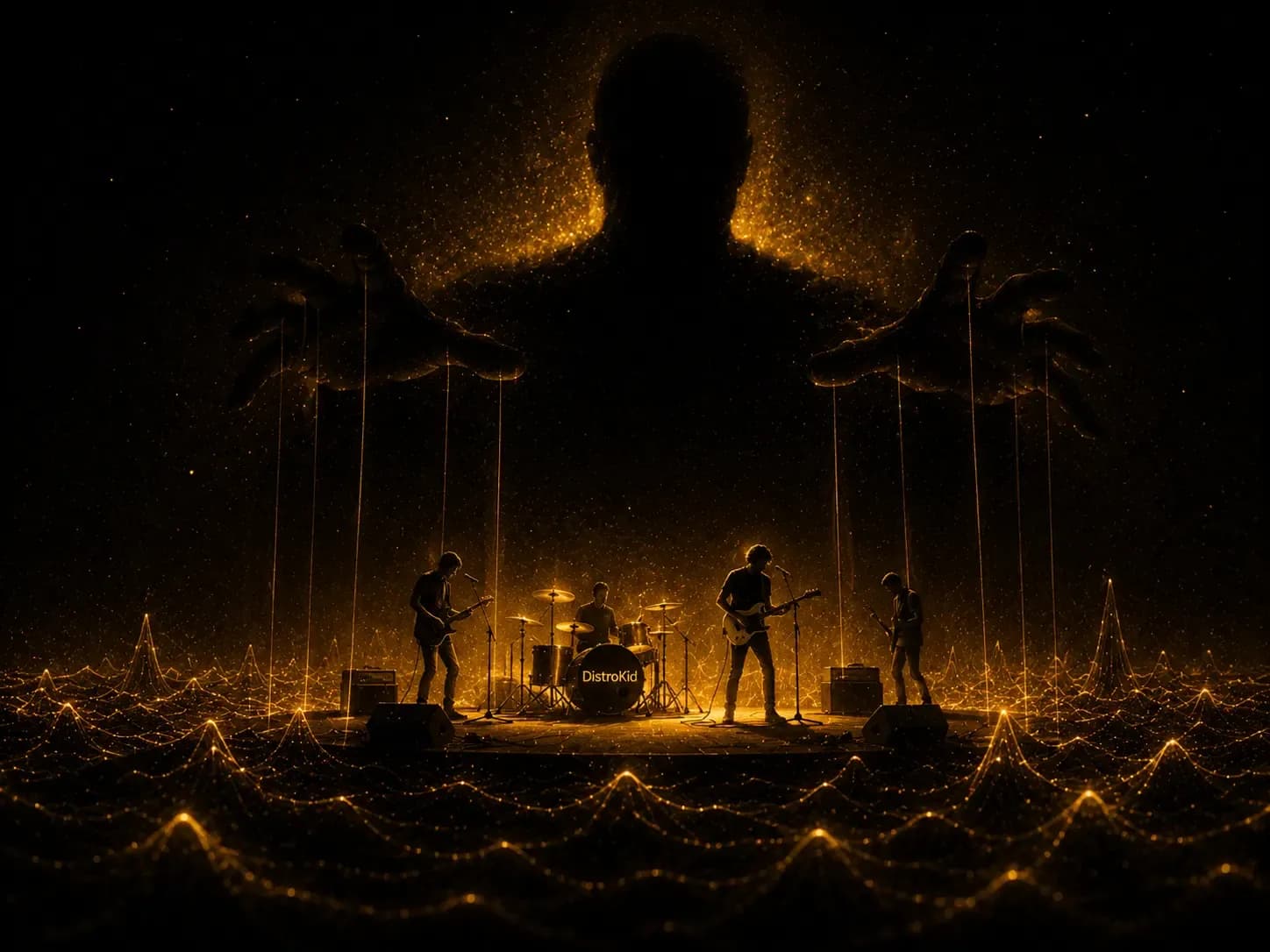
AI music changes the unit economics of making songs. When a creator can sketch, produce, revise and publish more quickly, each track stops feeling like a single high stakes release and starts looking like one asset in a wider portfolio. That does not make music less creative. It changes where the risk sits.
The old independent release model often asked artists to concentrate scarce time, money and attention into a small number of songs. A single, EP, or album had to justify months of writing, recording, mixing, artwork, promotion and distribution work. AI tools compress parts of that process. They do not remove taste, judgement, editing, branding, rights management, or audience building. They do, however, make it possible for more creators to test more ideas with less upfront production cost.
That shift matters because the audience has not expanded at the same pace as output. Listeners still have limited hours in the day. Platforms still have to rank, recommend and surface tracks. Streaming income still depends on repeated listening, not on the effort that went into a work. As production becomes easier, the bottleneck moves from making music to earning attention for it.
This is where the venture capital comparison becomes useful. Venture capital investors back many risky companies because they know most will not produce large returns. The aim is not for every bet to win. The aim is for a small number of exceptional outcomes to cover the weak ones and lift the whole portfolio. AI music can push creators toward a similar logic. A catalogue may contain many songs that earn little, while a few tracks find a durable audience and carry the economics of the whole project.
For musicians and AI artists, this does not mean throwing random music at platforms and hoping luck takes over. Portfolio thinking is not the same as careless volume. A serious catalogue still needs curation, metadata, genre positioning, artwork, sequencing, rights clarity and quality control. The point is that a creator can afford to explore more directions when each experiment costs less. A synthwave track, a lo-fi beat, a cinematic cue and a regional genre study can all become tests of listener demand, provided they are made and presented with intent.
At Lunar Boom, this is not an abstract question. We create original AI music across a wide range of genres, make music available royalty-free, and research how genres, tools and platforms are changing. That position makes the portfolio question practical. If the long-term goal is to build a broad catalogue, including music across as many genres as possible, then success cannot be judged only by whether each individual upload becomes popular. Some tracks may serve listeners immediately. Others may become useful later for creators, video editors, game makers, educators, or niche fans searching for a specific sound.
Still, catalogue size can hide a cost that creators should not ignore. Time is a real input even when software is cheap. If producing and publishing an album takes one hour, that hour has an opportunity cost. It could have been spent on paid work, promotion, client communication, learning, performance, licensing outreach, or rest. The right comparison is not between AI music and an imaginary zero-cost process. The fair comparison is between the revenue and strategic value of the release, and the best alternative use of the creator's time.
That calculation will vary. A hobbyist may value the process itself and accept little financial return. A commercial producer may need each hour to support a business. A label may release some music for direct streaming income, some for licensing utility, some for research, and some for audience development. In each case, the economics are different. The mistake is assuming that faster production automatically means better returns.
Listeners also feel the effects of this shift. A larger supply of music can be valuable when it expands choice and gives people access to sounds that traditional markets underproduced. It can also become exhausting if platforms fill with undifferentiated tracks that are hard to search, compare, or trust. The listener does not need every song to be a masterpiece. They do need signals that help them find music suited to a mood, setting, genre, or use case.
For platforms, the challenge is selection. If AI expands the number of releases, recommendation systems and editorial layers become more important, not less. Discovery tools will need to distinguish between repeatable utility, genuine audience response and simple volume. Rights holders will also care about provenance, licensing terms and whether a track can be safely used in commercial contexts. In an abundant market, clarity becomes a competitive advantage.
The portfolio model also changes how creators think about failure. A track that earns almost nothing may still teach something about genre demand, prompt design, arrangement choices, thumbnails, titles, playlist fit, or audience behaviour. That lesson has value only if the creator tracks it and applies it. Without feedback loops, volume becomes noise. With feedback loops, a catalogue becomes a map of experiments.
The central risk is that creators mistake quantity for strategy. AI can make it easier to release more songs, but it cannot guarantee that people will care. The more useful conclusion is narrower and stronger. AI lowers some production barriers, which makes diversified catalogues more realistic. In a market where attention and streaming revenue remain uncertain, the creator who treats songs as a managed portfolio may be better prepared than the creator who expects every release to behave like a standalone business.
That is not a cold view of music. It is a practical one. Creativity still matters, but in AI music it increasingly sits alongside allocation, testing and time management. The future catalogue may look less like a single artistic wager and more like a set of informed bets, where the goal is not to predict every winner in advance, but to build enough quality, variety and clarity for the winners to emerge.