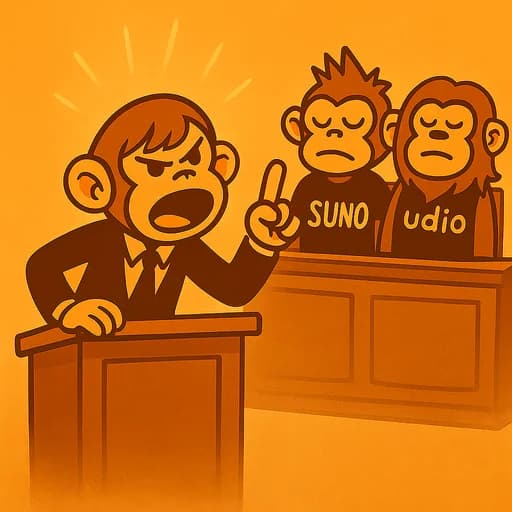
Major record companies sued Suno and Udio over allegations that copyrighted recordings were copied without permission to train AI music models. The cases put a basic question in front of the courts. When an AI company learns from commercial music, what permission does it need from the people who own that music?
Labels and independent artists filed cases
In 2024, the RIAA announced federal cases involving Sony, Universal, and Warner against Suno and Udio. The labels alleged widespread copying of copyrighted recordings during training. RIAA announcements
The source notes that statutory damages in copyright cases can reach $150,000 per work in some circumstances. Legal case overview
Independent country singer Tony Justice also brought class-action litigation, showing that the dispute was not limited to major-label catalogues. Class-action lawsuit
Streaming services faced a different AI problem
At the same time, streaming platforms were dealing with the volume of AI-generated uploads and fraudulent listening.
The source cites Deezer reporting that nearly 18% of daily uploads were AI-generated and describes its use of AI tagging and anti-fraud measures. Deezer AI tagging
Training disputes and streaming fraud are separate issues, but both affect how AI music fits into the existing music economy.
Licensing offers another route
The source also points to early discussions between major labels and AI companies over licensing arrangements. Labels negotiate licensing
A licensing model would not answer every legal question about past training, but it could provide a clearer basis for future use of copyrighted catalogues.
That is why the lawsuits matter beyond damages. They increase pressure on AI music companies and rights holders to define how training access, compensation, and permission should work before the technology becomes even more embedded in music production.